
Weekly lessons teach you; board-and-train builds the dog — a decent volume of work, sure, but more importantly every repetition read and ended by experienced judgment: when to do one more, when to stop, when to raise the pressure, and when the lesson has actually ingrained versus merely been complied with. Here’s the part nobody says out loud: lessons are the better business model for trainers — and usually the worse buy for owners, because even simple behaviors have to be built correctly from the first rep. And any board-and-train without a serious handoff process is renting you a trained dog, not giving you one.
When people ask me which format is better, I give them an answer they don’t expect: that’s the wrong question. Because the thing you’re really buying isn’t hours, and it isn’t repetitions. Let me explain.
It was never about the number of reps
My industry loves to sell volume. Thousands of repetitions! And look — a finished dog has done a decent amount of work; reps matter, up to a point. But if volume were the product, you could hand a bag of hot dogs to anyone with patience and a free month and get the same dog back. You can’t. Because the work was never the rep. The work is the read.
Watch an experienced trainer run a session, and pay attention to what they’re actually doing. They’re not counting. They’re answering questions — on every single repetition:
- Can we stop here, or is the lesson only half-landed?
- One more rep — or did that last one seal it, and one more just grinds the shine off?
- Did the dopamine actually release — did the light come on — or did the dog just comply?
- Has this ingrained deep enough to move on, or does moving on now build a crack we’ll find in month three?
- Is it time to push the boundary and make it harder?
- Raise the stress on the dog — or take stress off?
And underneath all of them, the one that separates professionals from everybody else: how do you know when it’s real? Not performed. Not tolerated. Ingrained. That’s the entire craft. It doesn’t come from a certification weekend or a YouTube playlist — it comes from reading thousands of dogs, session after session, year after year, until the answer is something you see rather than something you guess.
Rote repetition is the part an owner could do at home. It’s also the part that, done without the read, quietly makes dogs worse — sessions that run too long, lessons abandoned before they land, pressure added on a day the dog needed it taken away. So here’s the honest version of the comparison.
In weekly lessons, the hour with the trainer is usually fine. It’s the other 167 hours where every one of those judgment calls — one more or one less, push or back off, stop or keep going — is yours to make, after a ten-hour workday, with no one beside you who can tell the difference between a dog that finished learning and a dog that finished tolerating. Some owners genuinely develop that eye over months of committed work. Most — good, loving, busy people — don’t get the chance. Not because they don’t care. Because they have lives.
You can’t fix a behavior the dog is still practicing
Here’s the principle that decides most serious cases, and it’s one of the least understood things in dog training: every repetition of a behavior is training — whether you meant it or not. The dog that charges the window at every delivery truck while you’re at work is getting a hundred practice reps a week of the exact behavior you’re paying a trainer to remove. You do your Tuesday lesson, and the dog spends Wednesday through Monday rehearsing the counter-argument.
Dogs live in the land of always and never. Sometimes-and-maybe — corrected on the leash Tuesday, free to blow up through the fence Thursday — doesn’t just slow the training down. It breaks it. You cannot be fifty percent in on either side of a behavior and expect the dog to pick your side.
This is the real argument for a residential program, and notice it has nothing to do with luxury: total environmental control. At the facility, the reactive dog doesn’t spend eight unsupervised hours rehearsing at a window — every trigger they meet is one we staged, at a distance we chose, with a handler attached and a payoff planned. The behavior stops being practiced and starts being replaced. On twenty private acres with staff living on-site, there is no version of the day where the old pattern gets a free rep.
Where board-and-train programs fail
I’d be lying to you if I said the format can’t fail. It fails one specific way, and if you’re evaluating programs — mine included — this is the thing to interrogate: the handoff.
A dog trained by professionals, in a professional environment, will work beautifully for the professionals in that environment. If the program ends with a parking-lot dog-return and a handshake, what you’ve bought is a dog that behaves for someone else somewhere else. The behaviors came home; the leadership that holds them didn’t. Three weeks later the old patterns start creeping back, and the owner concludes board-and-train “doesn’t stick.” The training stuck fine. The transfer never happened.
That’s why the back end of every program we run is the front end of yours: go-home lessons where we teach you the system — the structure, the rules, the follow-through — plus follow-up support as the dog re-settles into your household. The dog you pick up should still be the dog you have at Thanksgiving. That’s the standard, and it’s why our methodology spends as much time on the humans as the dogs.
The honest decision guide
First, a disclosure my industry would rather I skip: private lessons are the best business model in dog training. The dollar-per-hour on lessons runs exponentially higher than on residential programs. If I were optimizing my margins, I’d sell you a lesson package today and book you through Christmas.
I generally don’t — because for most owners, lessons don’t produce results that hold. Not because owners are lazy or dumb. Because building a behavior correctly is a technical job from the very first rep. Even the “simple” stuff — a real heel, a place command the dog actually understands, a down that holds — carries the weight of being built right from the beginning: enough repetition to commit it to memory, and then the graduation — knowing when and how to increase difficulty — that ingrains it at a level that works in real life. Miss either half and you get a dog that performs in the kitchen and dissolves in the driveway. Most owners don’t have the knowledge, the hours, or the reps in their hands to do both halves. That’s not an insult; it’s the reason my trade exists.
Where weekly lessons genuinely fit:
- Maintaining and proofing a foundation that was already built correctly — tune-ups, new environments, handoff support after a program.
- The rare owner who treats training as a daily craft — structured sessions every day, and the patience to learn graduation, not just commands.
Board-and-train earns its keep when:
- The problem is serious — reactivity, aggression, a bite history, fear that’s running the household. Or the foundation simply deserves to be built correctly the first time.
- The behavior rehearses itself daily in your absence, so the practice-rep math can’t close at home.
- The foundation needs a real volume of well-read repetitions — each one ended at the right moment — which takes both time your schedule doesn’t have and an eye experience hasn’t built yet.
- The household is at the end of its rope — because a burned-out owner is an inconsistent owner, and the dog pays for that.
And a caveat I give people on the phone: a few problems are won or lost at your front door no matter where the foundation gets built. True separation anxiety is the classic example — we can build the obedience, the crate neutrality, and the independence reps here, but the neutral departures and reunions have to happen at your house, by you. Anyone who promises to ship that problem away entirely isn’t being straight with you.
What to ask any program before you write a check
Whether it’s us or anyone else, ask these five, and pay attention to whether the answers are specific:
- Where does my dog physically live during the program, and who is there at 3 AM?
- What decides when a training session ends — the clock, a rep quota, or the dog in front of you?
- How do you keep my dog from rehearsing the problem behavior between sessions?
- What exactly does the handoff include — how many lessons, what follow-up, for how long?
- What happens if the standard isn’t met by the end of the program?
That last one is where we part company with most of the industry. Every Agoge program is flat-rate and backed by the Agoge Commitment: if the standard isn’t met when the program ends, we keep working at no additional cost until it is. No clock to beat, no upgrade fees. Dogs don’t train on deadlines, and we don’t pretend they do.
If you’re weighing this decision for a dog with a real problem — in Nashville, Middle Tennessee, or far enough away that you’d be traveling in — start with the fifteen-minute call. I’ll tell you honestly which format your case needs, even when the answer is the cheaper one. It costs me nothing to be straight with you, and it’s how I’d want someone to treat my own dog.
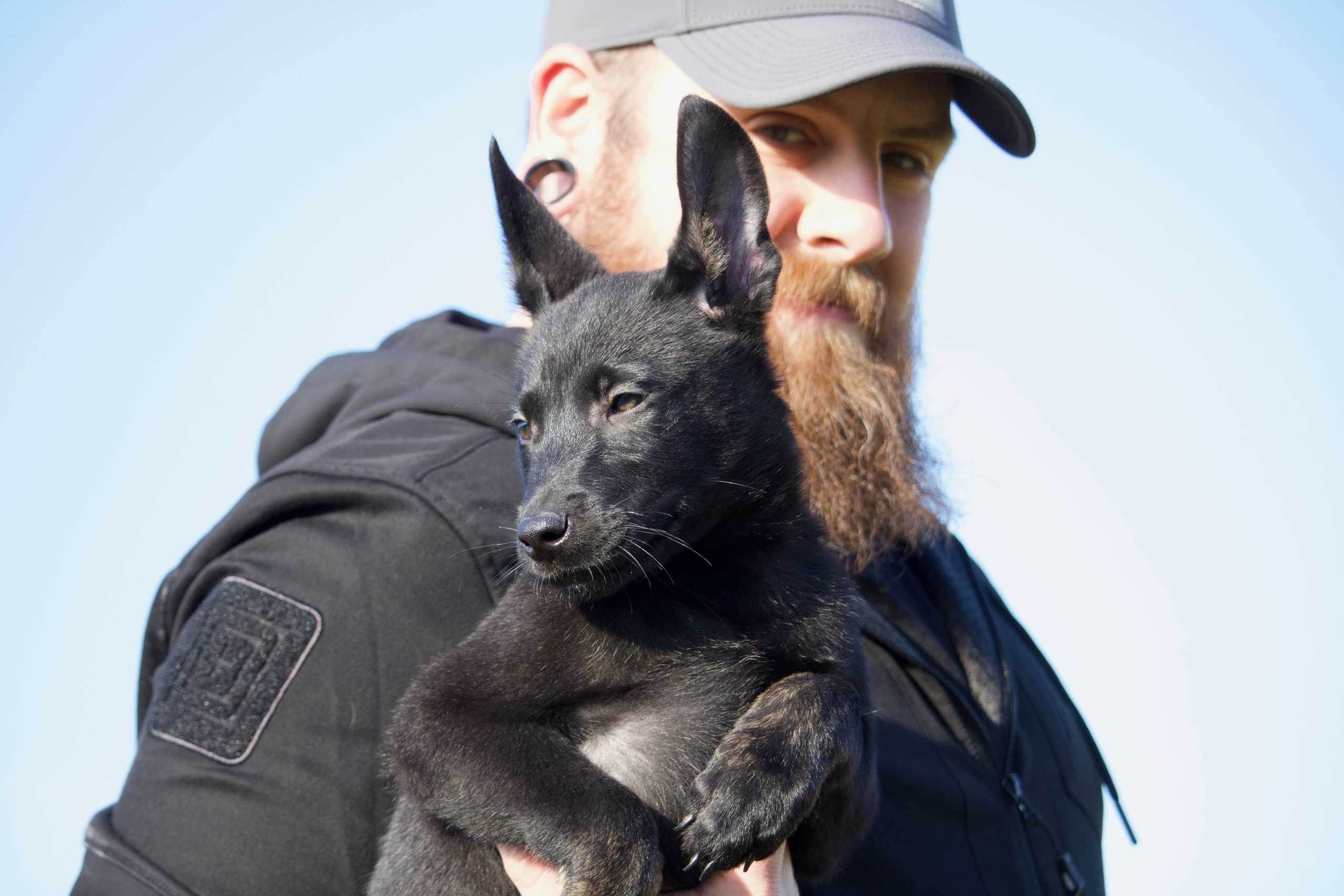
Brian Ferguson
Founder of Agoge K9 and a behavioral rehabilitation specialist with 23+ years and thousands of cases — including the national referrals other trainers turn away. He trains from a 20-acre facility in Hartsville, Tennessee. About Brian →